
01
Sense
Collect the inputs that actually describe the work: transactions, records, documents, events, APIs, model outputs, user input, telemetry, and external conditions. Time, identity, quality, and provenance travel with the input.
The work starts by tracing what happens today: where information originates, which context the decision needs, who or what has authority to act, how work is executed, and how the business confirms the result.
That trace usually exposes the real constraint quickly. Sometimes it is missing context. Sometimes it is model quality, queue growth, authority, data freshness, a brittle integration, or the lack of a reliable way to know whether an action completed.
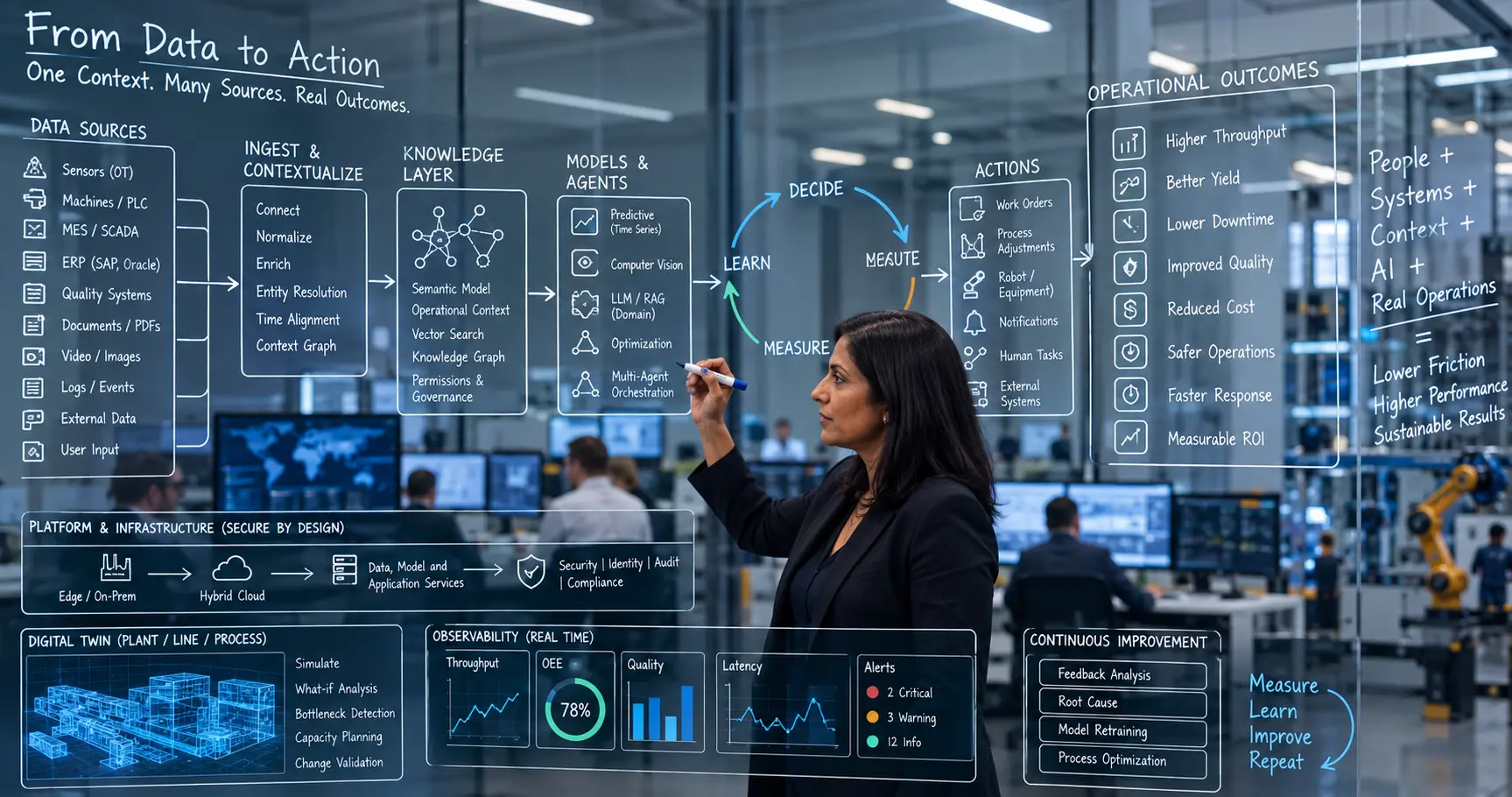
Each stage can look healthy in isolation and the process can still fail end to end. We measure the handoffs between stages because that is where stale state, lost identity, excess queueing, duplicate work, timing drift, and ambiguous outcomes tend to accumulate.
Collect the inputs that actually describe the work: transactions, records, documents, events, APIs, model outputs, user input, telemetry, and external conditions. Time, identity, quality, and provenance travel with the input.
Resolve the state needed for the decision. That may include recent history, asset identity, relationships, process state, limits, permissions, maintenance state, or what happened on the previous cycle.
Turn raw input into usable state through detection, tracking, classification, retrieval, anomaly detection, prediction, or model inference. We measure missed state and timing alongside model quality.
Apply the rules, models, policies, optimization, and human authority required for the specific operating decision. The decision path includes the evidence it depends on and the conditions under which it may act.
Carry the decision into the real process through an API, workflow, operator, downstream service, or—when the domain requires it—a controller or device. Actions are designed for retries, duplicate delivery, partial failure, and bounded authority.
Read the resulting state and confirm what happened. Unknown or conflicting state is reconciled explicitly. The evidence becomes input to recovery, tuning, and the next cycle.
We look at where work enters, how it is prioritized, where it waits, what shares resources, and which state has to remain consistent. That gives us a practical way to control latency and throughput before bursts and retries turn into an outage.

Define what may enter the system and which work wins when demand exceeds available capacity.
Send each workload to the execution boundary that satisfies latency, locality, isolation, and cost constraints.
Expose where work waits and slow producers before saturation becomes cascading failure.
Choose where aggregation improves efficiency and where continuous flow protects freshness.
Control concurrency, fairness, dependency order, and tail latency across shared resources.
Make one boundary authoritative for each state transition and define how replicas converge.
Bind work to the right compute class with explicit quotas, utilization, and displacement rules.
Recover from partial execution without duplicate effects, lost intent, or ambiguous final state.
Before changing architecture, we agree on the timing and outcome that matter. Instrumentation is added around that path so the team can see whether a change helped and where the next constraint moved.
P50 / P95 / P99 from source event to confirmed action, with stage timing where it helps isolate the constraint.
The required state present at decision time, including known gaps and confidence in missing or stale inputs.
Whether the selected context, perception, decision, and action are useful for the current process objective.
Age of the state relative to how quickly the process can change.
Observed process result after the command or workflow executes.
Throughput, queue growth, saturation, utilization, retry volume, recovery time, and cost under normal and burst conditions.
For a startup, we usually begin with the claim the product has to make true in the real world. We build the smallest complete path that can test sensing, context, decision timing, action, verification, and economics together. That gives the founding team evidence about what deserves to be hardened and what still needs to change.
For an enterprise, most of the pieces already exist: data, applications, models, infrastructure, people, procedures, and controls. We map the current path, find where state is lost or delayed, and change the minimum set of interfaces and components needed to improve the operating result.
A useful first conversation covers the current process, the systems and signals involved, the action that needs to happen, the timing constraint, and how the team knows the result was successful.